Am I a Sociopath – Signs, Traits, and What to Do Next
You have been turning this question over in your mind — am I a sociopath? Maybe a reaction you had (or didn't have) caught you off guard. Perhaps someone close to you pointed out a pattern that left you uneasy. Whatever brought you here, this question deserves a thoughtful, grounded answer — not a fear-driven label. In this guide, you will learn what sociopathy actually means, how it connects to antisocial personality disorder, the key traits professionals look for, and how it differs from psychopathy. You will also find a self-reflection checklist, relationship warning signs, and clear next steps — including ways to explore your Dark Triad personality profile for deeper self-understanding. This is not a diagnosis. It is a starting point for honest reflection.
What Does It Actually Mean to Be a Sociopath?
The word "sociopath" gets thrown around a lot — in true crime podcasts, relationship advice threads, and casual conversations. However, it is not a formal clinical term. Understanding what it actually refers to can help you move past stereotypes and toward genuine self-awareness.
Why "Sociopath" Isn't a Clinical Diagnosis
No mental health professional will diagnose you as a "sociopath." The term does not appear in the DSM-5 — the standard diagnostic manual used by clinicians. Instead, the behaviors and patterns that people associate with sociopathy fall under antisocial personality disorder (ASPD).
So why does the word persist? Because it captures a set of traits in everyday language — manipuliveness, low empathy, disregard for rules — that resonates with people trying to describe certain behaviors they observe. The problem is that using an informal label can oversimplify a complex condition.
How Sociopathy Connects to Antisocial Personality Disorder
ASPD is a recognized personality disorder characterized by a persistent pattern of disregarding or violating the rights of others. Core features include deceitfulness, impulsivity, irritability, and a lack of remorse. For a formal diagnosis, these patterns typically need to be present since at least age 15, and the individual must be at least 18.
When people say "am I a sociopath," they are usually asking whether their behavioral patterns align with ASPD traits. That is a valid question — but it is one that requires nuance, not a quick online label.
Key Signs and Traits Commonly Linked to Sociopathy
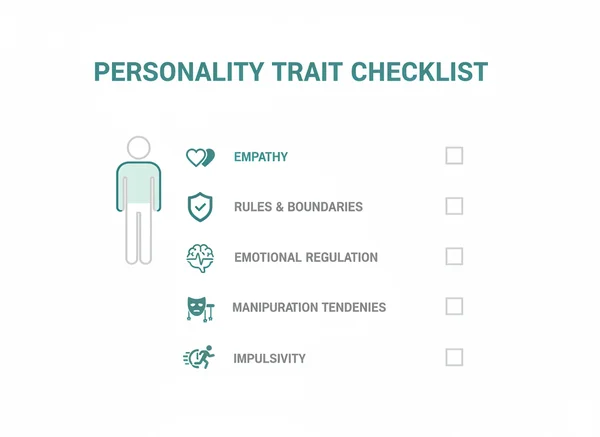
If you are wondering whether certain behaviors in yourself point toward sociopathic patterns, here are the traits most frequently associated with this profile. Keep in mind: having one or two of these traits does not make you a sociopath. Personality exists on a spectrum, and context matters.
Persistent Disregard for Rules and Boundaries
You may notice a pattern of ignoring rules — not just bending them occasionally, but consistently viewing them as irrelevant to you. This goes beyond teenage rebellion. It shows up as a persistent belief that norms apply to others, not to you. Examples include repeatedly breaking promises, lying without hesitation, or disregarding laws without concern for consequences.
Shallow Emotions and Limited Remorse
One of the most commonly cited traits is difficulty feeling deep emotions. You might notice that you can observe other people's pain without feeling much of anything. Guilt or remorse may feel foreign or performative — something you fake because you know it is expected, not because you genuinely experience it.
Manipulation and Superficial Charm
Sociopathic patterns often include a talent for reading people and using that insight to influence them. You might be exceptionally charming in first impressions but use that charm strategically — to get what you want rather than to build genuine connections. Manipulation can be subtle: flattery, strategic vulnerability, or creating emotional dependency.
Impulsivity and Reckless Decision-Making
Acting on impulse without considering consequences is another hallmark trait. This might look like making major life decisions on a whim, engaging in risky behavior for the thrill, or struggling to maintain long-term plans. The key distinction is a pattern of recklessness, not an occasional impulsive choice.
Can You Have Some Traits Without the Full Disorder?
Yes — and this is an important nuance. Many people show some traits associated with sociopathy without meeting the criteria for ASPD. Personality is dimensional, not binary. You can be low in empathy in certain situations, or occasionally manipulative, without having a personality disorder. What matters is whether these patterns are persistent, pervasive, and cause significant problems in your life or the lives of others.
Do Sociopaths Know They Are Sociopaths?
This might be the question behind the question. If you are genuinely wondering "am I a sociopath," does the fact that you are asking mean you probably are not one?
Not necessarily. Research suggests that many individuals with antisocial traits are aware that they think and function differently from those around them. They may recognize that their reactions are atypical — that they feel less guilt, care less about social rules, or view relationships more transactionally. However, this awareness often does not come with distress. In many cases, people with strong sociopathic traits simply do not see their patterns as a problem.
The very act of self-questioning suggests some degree of self-reflection — but it does not rule anything in or out. What it does suggest is that you are ready to look honestly at your patterns, and that is a meaningful first step regardless of where you land on any spectrum.
Sociopath vs Psychopath – How the Two Actually Differ
If you have been searching "am I a sociopath or a psychopath," you are not alone. These terms are often used interchangeably, but they describe different behavioral and emotional profiles. Neither is a formal diagnosis — both fall under the broader ASPD umbrella — but the distinctions are worth understanding.
Emotional Expression and Impulse Control
Sociopaths tend to be more impulsive and emotionally volatile. They may struggle to control outbursts, hold down jobs, or maintain stable routones. In contrast, psychopaths are often described as cool, calculated, and emotionally detached. They can mimic feelings convincingly without genuinely experiencing them.
Think of it this way: a sociopath may act out of frustration or emotion; a psychopath is more likely to act with deliberate, strategic intent.
Origins – Nature, Nurture, or Both?
Psychopathy is widely considered to have stronger biological and genetic roots — differences in brain structure and function that are present from an early age. Sociopathy, on the other hand, is more commonly associated with environmental factors — particularly adverse childhood experiences like abuse, neglect, or unstable caregiving.
In reality, most personality patterns involve a combination of both. Your genes may create a predisposition, but your environment shapes how those traits develop and express themselves.
Can a Sociopath Feel Love, Empathy, or Remorse?
This is one of the most emotionally loaded questions people ask — and the answer is more nuanced than a simple yes or no.
The Difference Between Shallow Attachment and Genuine Connection
People with sociopathic traits can form attachments. They may care about a partner, a parent, or a close friend — but the depth and nature of that attachment often looks different from typical emotional bonds. These connections may be driven more by what the other person provides (status, comfort, companionship) than by deep emotional resonance.
That does not mean the attachment is entirely fake. It means the emotional experience may be shallower and more conditional than what most people consider "love."
Why Charm Can Mask a Deeper Emotional Gap
Many individuals with sociopathic patterns are exceptionally charismatic. They can make you feel like the most important person in the room. However, this charm often serves a function — it is a tool for creating influence, not a reflection of genuine emotional connection. Recognizing this distinction is important, both for self-understanding and for evaluating your relationships.
How to Recognize Sociopathic Patterns in Relationships
Many people arrive at the question "am I a sociopath?" through relationship trouble. Whether you are questioning yourself or someone you are involved with, recognizing these patterns in a relational context can be illuminating.

Warning Signs in Romantic Relationships
If you notice the following patterns — in yourself or a partner — they are worth paying attention to:
- Love-bombing followed by withdrawal: Intense attention and affection early on, then sudden emotional distance.
- Consistent dishonesty: Lying about small things that do not seem to matter.
- Lack of accountability: Never accepting responsibility for mistakes or harm caused.
- Controlling behavior: Deciding who you see, how you spend your time, or monitoring your communication.
- Emotional flatness during conflict: Remaining completely calm or even amused during arguments that distress you.
Manipulation Tactics That Often Go Unnoticed
Some forms of manipulation are hard to recognize because they feel like normal relationship dynamics — until the pattern becomes clear. Gaslighting (making you doubt your own experience), triangulation (bringing a third person into conflicts), and intermittent reinforcement (alternating between warmth and coldness) are all tactics commonly associated with sociopathic relational patterns.
If you consistently feel confused, destabilized, or like you are "losing your mind" in a relationship, that is a signal worth examining.
What Causes Sociopathic Traits – Nature, Nurture, or Both?
Understanding where these traits come from can help contextualize them — for yourself or for someone you care about.
Genetic and Biological Factors
Research suggests that certain brain differences — particularly in areas controlling impulse regulation and emotional processing — may predispose individuals toward antisocial behavior. Family history of personality disorders or substance abuse can also increase risk. However, biology is not destiny. Having a genetic predisposition does not guarantee that sociopathic traits will develop.
Childhood Experiences and Environmental Triggers
Adverse childhood experiences play a significant role. Chronic neglect, physical or emotional abuse, inconsistent caregiving, and early exposure to violence can all contribute to the development of antisocial patterns. For many individuals, these traits emerge as survival mechanisms — ways of navigating an environment that was unpredictable or unsafe.
When environmental stressors meet a genetic vulnerability, the likelihood of developing strong antisocial traits increases substantially.
Exploring Your Dark Triad Profile for Self-Understanding
If reading this article has made you curious about your own personality patterns, you are not alone. Many people find it helpful to take a structured approach to self-reflection — one that goes beyond a single label and looks at the broader landscape of personality traits.
What the Dark Triad Framework Reveals About Personality
The Dark Triad is a well-researched psychological framework that measures three interconnected personality traits: Machiavellianism (strategic manipulation), narcissism (excessive self-focus), and psychopathy (lack of empathy and remorse). Everyone falls somewhere on each of these dimensions. Understanding where you land can help you recognize patterns that influence your relationships, decisions, and self-perception.
This is not about labeling yourself as "good" or "bad." It is about gaining insight into tendencies that you can then choose to work with — or work on.
How a Self-Reflection Assessment Can Help You Organize Your Thoughts
A structured assessment gives you a framework for thinking about your traits in a concrete way. Rather than spiraling in abstract self-questioning, you get a starting point for deeper reflection.
The Dark Triad personality test is designed for exactly this purpose. It is an educational tool — not a clinical diagnosis. Think of it as a way to organize your thoughts, identify patterns, and decide whether further exploration (including professional support) makes sense for you.
This assessment is for educational and self-reflection purposes only. It does not diagnose any mental health condition and is not a substitute for professional evaluation.
When Self-Reflection Calls for Professional Support
Asking "am I a sociopath?" takes courage. Regardless of where your self-reflection leads, here are the key takeaways from this guide:
- "Sociopath" is not a diagnosis. The clinical term is antisocial personality disorder (ASPD), and only a licensed professional can assess it.
- Personality traits exist on a spectrum. Having some sociopathic traits does not automatically mean you have a disorder.
- Self-awareness is a strength. The fact that you are examining your patterns puts you in a better position to make intentional choices.
- Context matters. Traits look different depending on relationships, stress levels, and personal history.
Consider reaching out to a mental health professional if:
- These patterns are causing significant harm to your relationships or daily functioning.
- You feel unable to change behaviors that you recognize as harmful.
- You want a clearer understanding of your personality beyond self-assessment.
- Someone you trust has expressed concern about your behavior patterns.
Your next step does not have to be dramatic. It can be as simple as exploring your Dark Triad profile to gain perspective — or scheduling an initial conversation with a therapist. Either way, you are moving forward.
Frequently Asked Questions
Are sociopaths born or made?
Most evidence suggests a combination of both. Genetic and biological factors can create a predisposition, while adverse childhood experiences — such as neglect, abuse, or unstable caregiving — often influence whether those traits fully develop. Neither nature nor nurture alone provides a complete explanation.
What does a high-functioning sociopath look like?
A high-functioning sociopath may appear successful, charming, and well-adjusted on the surface. They often maintain careers, social networks, and relationships while internally experiencing reduced empathy, strategic thinking about interpersonal dynamics, and limited genuine emotional connection.
Can you be a sociopath and still have empathy?
Some individuals with sociopathic traits experience cognitive empathy — the ability to understand what someone else is feeling — without experiencing emotional empathy, which involves genuinely sharing that feeling. So partial empathy is possible, but it often feels more analytical than instinctive.
How can you tell if someone is a sociopath in a relationship?
Look for persistent patterns rather than isolated incidents: consistent dishonesty, emotional manipulation, lack of accountability, love-bombing followed by withdrawal, and a tendency to make you doubt your own perceptions. If these patterns are ongoing and cause distress, professional guidance may help.
How does sociopathic behavior affect romantic relationships?
Sociopathic behavior can create cycles of intensity and detachment that leave partners feeling confused and emotionally drained. Common dynamics include manipulation, lack of genuine remorse after conflict, superficial charm that fades over time, and difficulty maintaining emotional intimacy.