Dark Triad Face: What Facial Feature Studies Can and Cannot Tell You
Searches for "dark triad face" often come from a very human question: can you tell something important about a person just by looking at them? The careful answer is narrower than most viral posts suggest. Some studies have tested whether people can infer Dark Triad traits from neutral or composite faces, but the evidence is mixed, context-dependent, and easy to overread. A face may shape first impressions, yet it cannot replace behavior, history, or structured self-reflection. If you are exploring these traits for yourself, a private tool for structured Dark Triad self-reflection is a safer starting point than judging a stranger's jawline, smile, or eye contact.
What People Mean by a Dark Triad Face
A "dark triad face" is not a formal category. It is a search phrase people use when they want to connect appearance with three personality trait dimensions: Machiavellianism, narcissism, and psychopathy. In everyday language, people may imagine a cold stare, a sharp smile, a dominant jaw, or a celebrity-like confidence. Those impressions can feel convincing, especially when a person already behaves in manipulative, entitled, or callous ways.
The problem is that impressions are not measurements. Faces carry real social information, such as expression, grooming, fatigue, age cues, and emotion. They also trigger bias. We may mistake confidence for narcissism, nervousness for dishonesty, attractiveness for kindness, or an unsmiling expression for cruelty. A dark triad face test that promises certainty from a photo would oversell what personality science can support.
For SEO searches like "dark triad facial features male" or "dark triad facial features female," the best answer is not a list of fixed features. It is a framework for reading the research carefully. Ask what kind of image was studied, whether the face was neutral or expressive, whether researchers used real individuals or composites, and whether the result applied to one trait or all three.
What Face Studies Have Actually Looked At
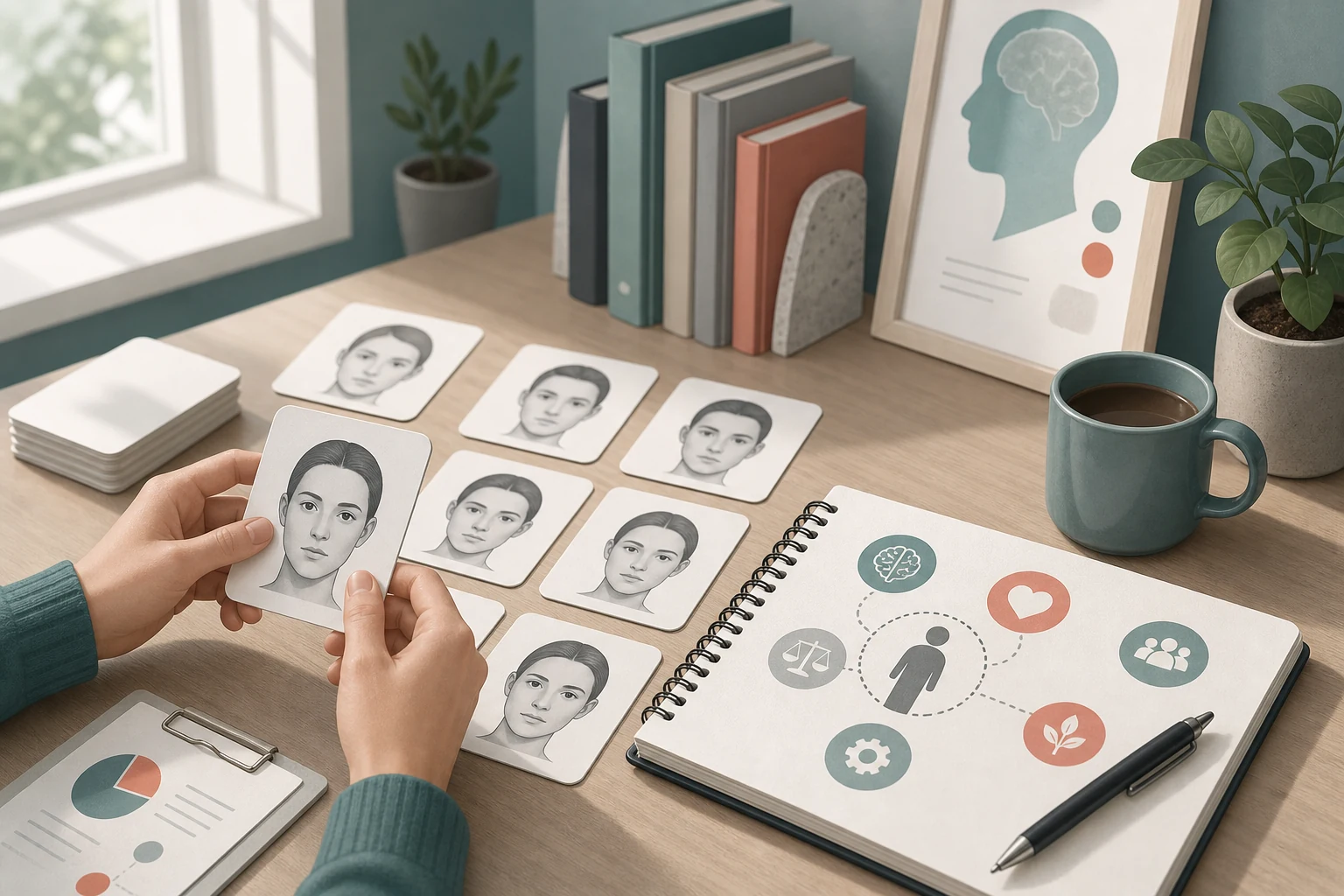
The most relevant dark triad face study designs usually use standardized photos, composite faces, or forced-choice judgments. Participants may be shown two neutral faces and asked which one seems higher in narcissism, Machiavellianism, or psychopathy. In other studies, researchers build average faces from people who scored higher or lower on a Dark Triad scale, then test whether observers can choose the high-trait prototype above chance.
This matters because a composite face is not the same as meeting one person in real life. A composite smooths together many faces. It may amplify subtle average differences that are not reliable in a single individual. Standardized lab photos also remove clothing, posture, voice, conversation style, social status cues, and situational behavior. That gives researchers a cleaner test, but it also makes the finding less useful for everyday judgment.
The findings are not one simple story. Some studies suggest observers can identify certain traits above chance in prototypes. Other research finds stronger evidence for narcissism cues than for Machiavellianism or psychopathy. A newer study using Japanese participants and composite facial photographs found that participants could infer all three traits from female faces in that task, but not from male faces overall. Those differences show why the headline "you can see the Dark Triad in a face" is too broad.
Dark Triad Facial Features Female and Male: Why Search Results Differ
Search results often split the topic by gender because research sometimes reports different outcomes for male and female targets. That does not mean there is a universal female dark triad face or male dark triad face. It means the relationship between facial perception and trait inference can change depending on the sample, culture, target sex, observer sex, and method.
For female faces, some studies have found that observers can distinguish high-trait composites more accurately than chance in certain tasks. For male faces, results can be weaker, mixed, or trait-specific. A study may find a signal for narcissism but not for the other traits. Another may find above-chance judgments under a different design. When the pattern changes across studies, a cautious reader should treat it as an open research question, not a practical screening tool.
There is also a social risk. Gendered searches can slide into stereotyping quickly. A woman's neutral expression may be labeled "cold." A man's broad face may be labeled "dangerous." A confident smile may be treated as evidence of narcissism. These shortcuts can harm innocent people and can also distract you from the behaviors that matter most: honesty, empathy, respect for boundaries, accountability, and how someone responds when they do not get their way.
Is the Dark Triad About Looks?
No, the Dark Triad is about personality traits, not looks. Machiavellianism describes a tendency toward strategic manipulation and cynical social calculation. Narcissism involves grandiosity, entitlement, and a strong need for admiration. Psychopathy, as a non-clinical personality trait dimension in this context, involves lower empathy, impulsivity, and callousness. These traits are usually studied with questionnaires, behavioral patterns, peer ratings, or experimental tasks.
Looks may influence how people are perceived, but perception is not the trait itself. A person can look intense and be considerate. Another person can look charming and still behave exploitatively. A smile can be warm, strategic, nervous, practiced, flirtatious, or simply polite. The phrase "dark triad smile" is popular because smiles can feel meaningful, but a smile alone cannot tell you whether someone is manipulative or low in empathy.
This is why a private personality traits test is more appropriate for self-exploration than face-reading. Even then, test results should be treated as educational feedback, not a permanent identity. They can help you notice tendencies, compare patterns across the three dimensions, and decide what to reflect on next.
Why Dark Triad Face Tests Are Easy to Misuse
A dark triad face test sounds simple: upload a photo, get a personality judgment. The simplicity is exactly the danger. Face-based personality claims can create false confidence because they turn a complex, context-sensitive construct into a visual label. Personality traits are patterns across time. They are not single-frame conclusions.
There are four common misuse patterns:
- Treating a research average as a rule for individuals.
- Ignoring cultural, age, lighting, grooming, and expression differences.
- Confusing attractiveness, dominance, or confidence with darker traits.
- Using appearance to judge someone while overlooking repeated behavior.
The safer question is not "Does this person have a dark triad face?" A better question is "What patterns have I actually observed?" Do they respect limits? Do they accept responsibility? Do they show care when another person is affected? Do they use charm mainly to gain control? Do their stories change when accountability appears?
How to Tell if Someone Shows Dark Triad Patterns
If you are concerned about someone's behavior, focus on repeated actions rather than facial features. A useful observation checklist looks at patterns over time:
- They often frame relationships as competitions to win.
- They use flattery, guilt, or selective honesty to influence people.
- They seem highly invested in admiration or status.
- They dismiss other people's discomfort as weakness or inconvenience.
- They avoid accountability by blaming, minimizing, or changing the subject.
- They treat boundaries as obstacles rather than information.
One behavior is rarely enough. Everyone can be defensive, vain, strategic, or emotionally flat in a bad moment. Patterns matter when they repeat across situations, especially when the person benefits and others pay the cost. If the relationship feels unsafe, coercive, or abusive, prioritize support, documentation, and distance where possible. For workplace or family situations, consider advice from a qualified professional, HR, legal support, or a trusted local service depending on the risk level.

Dark Triad Face vs Light Triad Face
The related search "light triad face" points to another important limitation. The Light Triad describes a more humanistic orientation, often associated with faith in humanity, humanism, and Kantian respect for people as ends rather than tools. It is tempting to imagine that warmth, trustworthiness, or kindness must have a visible face pattern too.
In everyday life, kindness may show through expression, attention, and behavior. But that is still different from claiming a fixed facial structure reveals someone's moral orientation. A calm face is not proof of compassion. A sharp face is not proof of harm. The Light Triad vs Dark Triad comparison is more useful when it moves you away from appearance and toward interpersonal habits: exploitation versus respect, entitlement versus reciprocity, image management versus genuine care.
For self-reflection, the comparison can be constructive. You might ask: when I want something, do I still respect the other person's autonomy? When I feel criticized, do I become curious or contemptuous? When I have power, do I use it to clarify expectations or to control the room?
A Better Way to Use Dark Triad Face Research
Dark triad face research is interesting because it shows how quickly humans form social impressions. It may help explain attraction, suspicion, charisma, and the way people react to neutral faces. But the best use of this research is humility. It should make us slower to overclaim, not faster to label people.
Use the topic as a prompt for better questions:
- What evidence do I have beyond appearance?
- Am I reacting to behavior, or to a stereotype?
- Could stress, culture, neurodiversity, or context explain the expression I am reading?
- Have I checked whether the same pattern appears across time?
- What boundary would protect me without turning uncertainty into accusation?
If your interest is personal growth, an educational Dark Triad assessment can give you a structured way to think about Machiavellianism, narcissism, and psychopathy traits in yourself. Use the result as a mirror for reflection, not as a label for who you are or a verdict on anyone else's face.
FAQ
How to tell if someone is Dark Triad?
Look for repeated behavior patterns, not facial features. Dark Triad patterns may include manipulation, entitlement, low empathy, chronic boundary-pushing, and strategic charm. The key is repetition across contexts. One awkward smile, intense stare, or confident posture is not enough.
Is Dark Triad about looks?
No. The Dark Triad refers to personality trait dimensions: Machiavellianism, narcissism, and psychopathy. Appearance can influence first impressions, and researchers have studied face-based judgments, but looks are not the construct itself.
Can you tell narcissism by looking at a face?
You may form an impression, but you cannot reliably know narcissism from a face alone. Some research suggests narcissism may be more visible than the other Dark Triad traits in certain composite-face tasks. That does not make a single person's face a dependable measure.
What does a dark triad smile mean?
A smile can mean many things: warmth, politeness, confidence, nervousness, social performance, or strategy. A "dark triad smile" is more of a pop-culture idea than a reliable personality signal. Pay attention to whether the person's behavior shows respect, empathy, and accountability.
Are male dark triad face traits different from female ones?
Some studies report different accuracy patterns for male and female face stimuli, but the findings are not stable enough to create a checklist of male or female features. Treat gendered claims cautiously because they can easily become stereotypes.
What are the top 3 worst personality disorders?
That question is not a helpful or respectful way to think about mental health. The Dark Triad is a trait model, not a ranking of personality disorders. If you are worried about harm, focus on concrete behavior, safety, boundaries, and professional guidance when needed.
Should I use a dark triad face test?
Use caution. A face-only test can encourage overconfidence and unfair labeling. If you want insight, choose structured self-reflection tools and compare the results with real behavior patterns, feedback from trusted people, and your own values.