Dark Triad Personality Test: How to Understand Scores Without Labeling Yourself
A dark triad personality test can be useful when you want language for patterns that feel hard to name: strategic control, admiration-seeking, emotional distance, impulsivity, or low empathy in certain situations. The key is to treat the result as a self-reflection map, not a verdict on your character. A good test should help you compare Machiavellianism, narcissism, and psychopathy traits in a measured way, while leaving room for context, growth, and professional support when needed. If you want a calm starting point, a structured Dark Triad personality test can help you explore the three dimensions without turning the topic into a label.
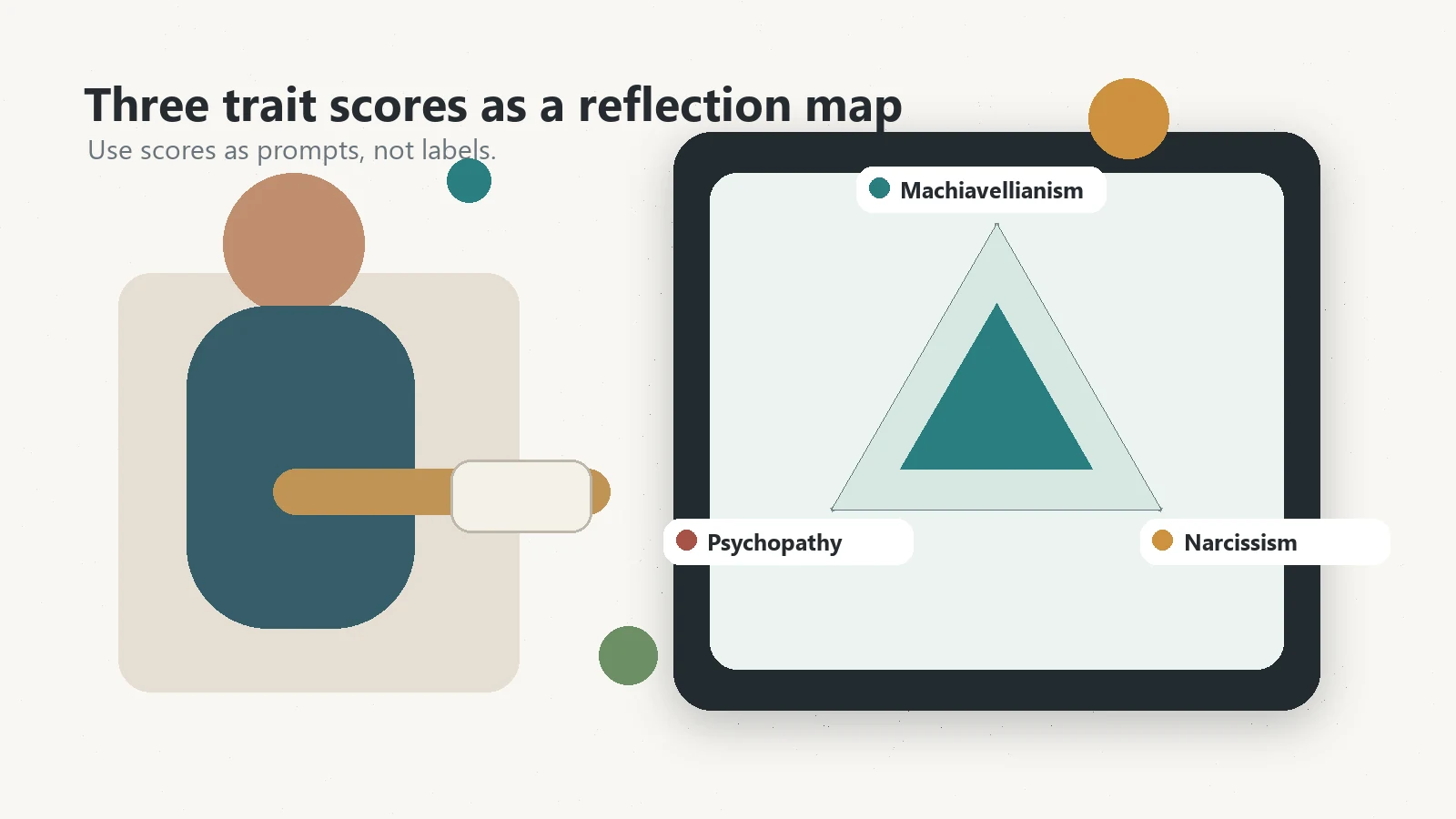
What a Dark Triad Personality Test Actually Measures
The Dark Triad is a personality framework that groups three socially difficult but non-identical trait clusters: Machiavellianism, narcissism, and psychopathy. The term was popularized in personality research by Delroy Paulhus and Kevin Williams, and later short-form tools such as the Dirty Dozen and the Short Dark Triad, often called SD3, made the construct easier to study and discuss.
In everyday language, people often use "dark personality test" as if it were a simple good-or-bad scanner. That is not the most useful way to read it. Most online tools estimate tendencies on a spectrum. A person may score higher on one dimension, lower on another, and behave differently depending on stress, incentives, social norms, maturity, and feedback. Scores can point toward habits worth noticing, but they do not replace a full psychological evaluation.
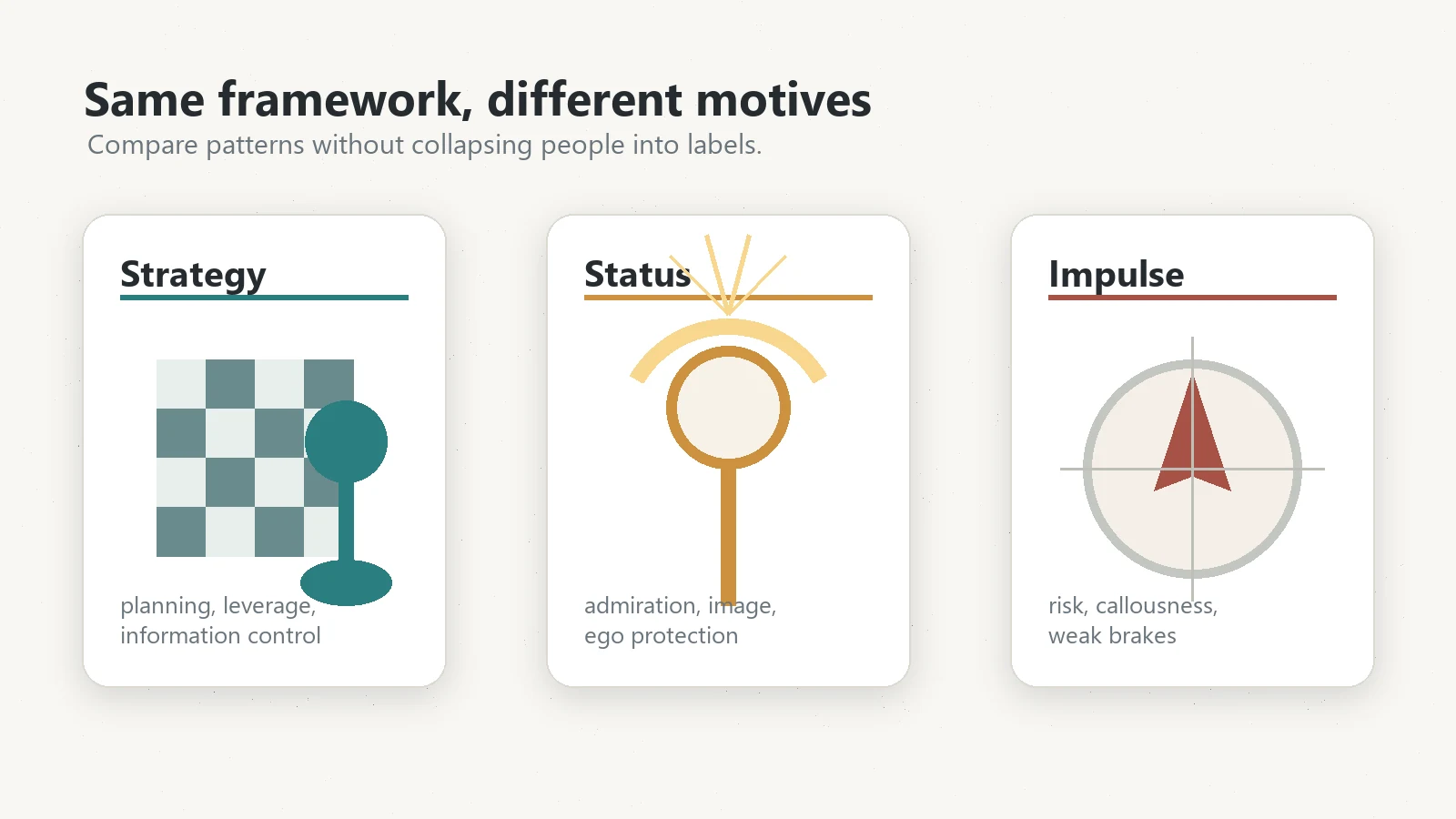
Machiavellianism is usually about strategy, distrust, and willingness to influence situations for personal advantage. Narcissism focuses more on status, admiration, self-importance, and sensitivity to ego threat. Psychopathy, in the subclinical personality-trait sense used in many self-report tools, often refers to callousness, impulsivity, thrill seeking, and reduced guilt or fear. These traits can overlap, yet the motivations behind them are different enough that lumping them together can hide useful detail.
Machiavellianism vs. Narcissism vs. Psychopathy
One common search question is, "What is Machiavellian vs narcissist vs psychopath?" The short answer is that the three traits can lead to similar-looking behavior but from different psychological routes.
Machiavellian patterns tend to be cool, calculated, and long-range. Someone high in this dimension may think in terms of leverage, information control, and practical outcomes. The red flag is not simply being strategic; planning can be healthy. The concern appears when strategy repeatedly becomes deception, exploitation, or disregard for consent and fairness.
Narcissistic traits center on self-image. At moderate levels, confidence and ambition can look socially rewarded. At higher or more rigid levels, the pattern may include entitlement, defensiveness, envy, status comparison, or a strong need to be seen as exceptional. Narcissism is part of the Dark Triad, but narcissistic traits are not the same as narcissistic personality disorder. The article should stay with traits unless a qualified clinician is involved.
Psychopathy, as measured in many personality tests, is about callousness, low fear, impulsivity, and weaker emotional braking. It is not the same thing as movie-villain behavior. In self-report settings, it may show up as risk-taking, boredom, reduced remorse, or difficulty caring about consequences for others. Because the word carries heavy stigma, it is especially important to read this scale cautiously.
How to Read Your Score Without Overreacting
A free dark triad personality test can be helpful if you read it like a mirror with limits. It can organize reflection, but it cannot know your life history, relationships, mental health context, culture, or current stress load. A high score is best treated as a prompt to ask better questions, not as a fixed identity.
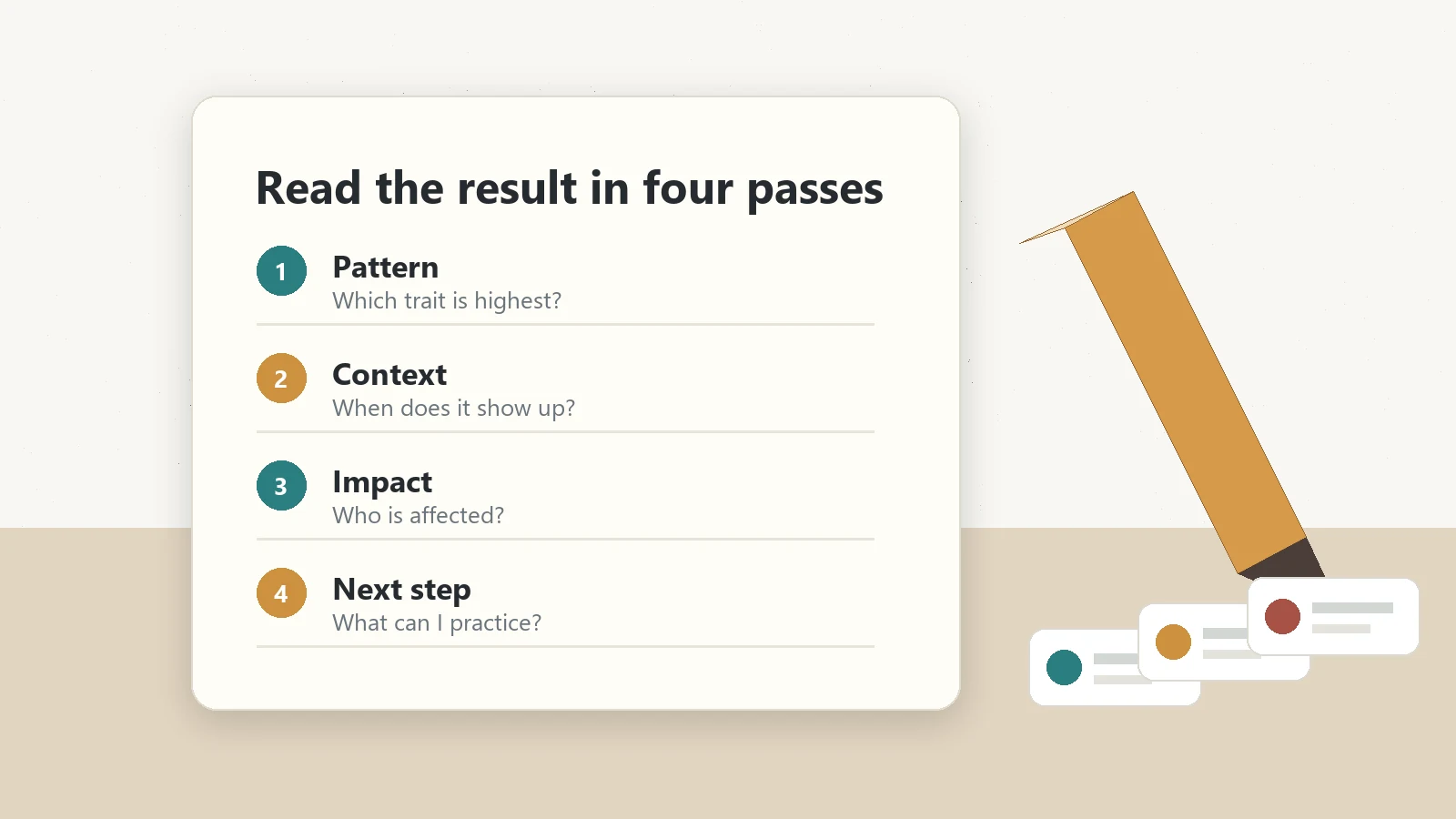
Start with the pattern, not the label. Ask which dimension is highest, which is lowest, and whether the score fits repeated behavior across time. A one-time conflict, a stressful job, or a defensive mood can distort how you answer. If the result surprises you, retake the test later under calmer conditions and compare what changed.
Next, translate each score into observable situations. Instead of "I am manipulative," try "When I feel threatened, do I hide information or push people toward my preferred outcome?" Instead of "I am narcissistic," ask "Do I become dismissive when I feel criticized?" Instead of "I lack empathy," ask "When do I slow down enough to consider another person's experience?" This shift keeps the result practical and less shaming.
When you use an educational dark personality test, look for explanations that separate traits from disorders, acknowledge uncertainty, and encourage reflection rather than fear. That makes the result easier to use in real life: improving communication, noticing boundary problems, or deciding whether a conversation with a mental health professional would be useful.
Short Dark Triad Test, SD3, Dirty Dozen, and Online Quizzes
Search results often mix several tools together: short dark triad test, Short Dark Triad (SD3), Dirty Dozen, IDRlabs-style quizzes, and general dark personality test pages. They are not all identical.
The Dirty Dozen is a very brief measure built for efficiency. It can be convenient, but shorter scales usually trade detail for speed. The SD3 is longer, with 27 items, and is widely discussed because it attempts to give each of the three traits enough room to be measured separately. Many online quizzes adapt or simplify these research traditions, but their scoring, wording, and explanations can vary.
That does not mean online tests are useless. It means you should look for transparency. A stronger experience explains what the test is trying to measure, how many questions it uses, what each scale means, and what the result cannot tell you. Be cautious with any page that promises certainty, turns a score into an insult, or encourages you to use the result to judge someone else without context.
If you are comparing a dark triad personality test online with a PDF worksheet, a Big Five test, a Light Triad test, or the Dark Factor of Personality concept, remember that each framework answers a different question. The Big Five describes broad personality dimensions. The Light Triad emphasizes humanistic and prosocial orientations. The Dark Factor looks for a broader common core behind harmful tendencies. The Dark Triad focuses specifically on three named trait clusters, which makes it useful but not complete.
What Results Can and Cannot Tell You
Your result can suggest areas to watch. A high Machiavellianism score might invite reflection on honesty, control, and whether you treat people as partners or pieces on a board. A high narcissism score might invite reflection on criticism, admiration, entitlement, and repair after conflict. A high psychopathy-related score might invite reflection on impulse control, empathy, risk, and accountability.
Your result cannot fully explain why a pattern exists. Similar behavior can come from stress, trauma responses, insecurity, social learning, competitive environments, substance use, immaturity, or a separate mental health concern. A questionnaire cannot interview people who know you, observe your relationships, or evaluate safety concerns.
It also cannot tell you whether another person is a "narcopath," a sociopath, or a dark empath. Those terms are popular online, but they can flatten complex behavior into a dramatic label. If you are trying to understand someone else's behavior, focus on what you can observe: repeated lying, intimidation, boundary pushing, lack of accountability, or emotional harm. You do not need a label to set limits around behavior that is unsafe or disrespectful.
A Practical Reflection Framework After the Test
Use the result as a starting point for one small behavior experiment. Pick the highest scale and choose one observable pattern connected to it. Then track it for a week in low-drama language.
For Machiavellianism, the experiment might be directness: "In one conversation, I will state my goal plainly instead of steering indirectly." For narcissism, it might be repair: "When I feel criticized, I will pause before defending myself and ask what impact my behavior had." For psychopathy-related traits, it might be consequence awareness: "Before I act on impulse, I will name who could be affected and what I would need to repair."
The goal is not to become a perfect person after one quiz. The goal is to turn a score into a pattern you can observe, discuss, and adjust. If the result brings up distress, relationship harm, aggression, self-harm thoughts, or fear for anyone's safety, it is wise to seek help from a qualified professional or a local support service. Educational self-tests work best when they support care, not isolation.
Choosing a Dark Triad Personality Test Responsibly
The best dark triad personality test for everyday self-reflection is clear, measured, and non-judgmental. It should explain the three traits, avoid moral panic, and remind you that personality scores are not permanent character sentences. It should also respect privacy and avoid pushing you toward a dramatic identity.
Before you complete a test, ask three questions. First, does it measure Machiavellianism, narcissism, and psychopathy separately? Second, does it explain limitations in plain language? Third, does it help you think about behavior, relationships, and growth instead of simply ranking you as good or bad?
For a grounded next step, explore a non-judgmental Dark Triad test experience and read your score as one data point. A dark triad personality test is most useful when it gives you vocabulary, not a cage.

FAQ
How do I know if I am Dark Triad?
You cannot know from one label or one online result. A dark triad personality test can highlight tendencies related to Machiavellianism, narcissism, and psychopathy, but the more useful question is whether certain patterns repeat across time. Look for behavior, context, impact on others, and willingness to repair harm.
Is narcissism part of the Dark Triad?
Yes. Narcissism is one of the three Dark Triad dimensions, alongside Machiavellianism and psychopathy. In this context it refers to traits such as grandiosity, entitlement, admiration-seeking, and sensitivity to ego threat. It is not automatically the same as narcissistic personality disorder.
What are the four dark personality types?
People asking this usually mean the Dark Tetrad, which adds everyday sadism to the Dark Triad. The classic Dark Triad includes Machiavellianism, narcissism, and psychopathy. The Dark Tetrad is a related but broader framework, so it should not be mixed into a three-trait score unless the test explicitly measures it.
Is a short Dark Triad test accurate?
A short test can be useful for quick reflection, but shorter tools usually provide less detail than longer assessments. Accuracy also depends on honest answers, clear wording, scoring quality, and interpretation. Use a short result as a screening-style signal, not as a final statement about who you are.
What is the difference between a Dark Triad test and a Light Triad test?
A Dark Triad test focuses on traits linked with manipulation, self-importance, callousness, and impulsive risk. A Light Triad test focuses on more humanistic traits, such as seeing people as ends rather than tools. They can be interesting together, but they are measuring different sides of personality.
Can I use a Dark Triad personality test to judge someone else?
Be careful. Answering for someone else is less reliable because you are guessing their motives and inner experience. If another person's behavior worries you, focus on observable patterns and boundaries: honesty, respect, safety, accountability, and how they respond when you say no.