Narcissism and Psychopathy: Understanding the Key Differences
Have you ever encountered someone who seemed incredibly charming yet strangely cold? You might find yourself searching for terms like narcissism and psychopathy to make sense of their confusing behavior. It is very common to feel overwhelmed when these labels are used interchangeably in movies or social media discussions. However, understanding the specific nuances between these personality traits is essential for your emotional safety and personal self-awareness. This guide will help you distinguish between the two, explore their hidden overlaps, and provide a clear framework for recognizing these patterns in real-life situations. By the end of this article, you will have a better grasp of these complex human behaviors and how they impact your world. You can also explore our Dark Triad test online to gain deeper insights into your own unique personality structure.
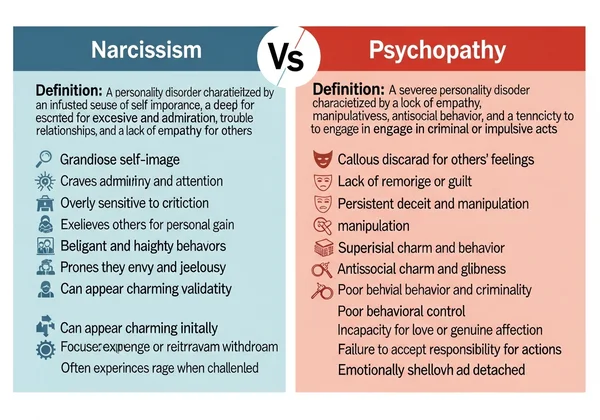
Personality Architecture: Defining Narcissism and Psychopathy
To understand the relationship between narcissism and psychopathy, we must first look at their distinct psychological foundations. While both traits exist on a spectrum, their "internal engines"—the motivations that drive their every action—are fundamentally different.
The Anatomy of Narcissism: The Drive for Validation
At its core, narcissism is fueled by a profound and constant need for external validation. A person with high narcissistic traits often possesses an inflated sense of self-importance. They truly believe they are special and deserve unique treatment from everyone they meet. However, this grandiosity often masks a fragile ego. They are essentially "ego-driven." Everything they do is designed to protect their self-image and secure what psychologists call "narcissistic supply"—a steady stream of admiration from others. If you stop providing that praise, the narcissist often reacts with intense hurt or anger because their sense of worth depends entirely on your reflection of them.
The Core of Psychopathy: Callousness and Lack of Remorse
Psychopathy, on the other hand, is defined by a lack of emotional depth and a startling absence of remorse. While a narcissist needs you to love them, a psychopath simply needs you to be useful to their goals. They are "utility-driven." These individuals often display callousness, impulsivity, and a total disregard for social norms or the feelings of others. Because they do not experience guilt in the same way most people do, they can move through life with a predatory focus. Their charm is not a reflection of their feelings; it is a carefully chosen tool used to achieve a specific result.
Narcissist vs. Psychopath vs. Sociopath: A Comparison Framework
When people discuss narcissism and psychopathy, the term "sociopath" often joins the conversation. While these terms overlap in popular culture, a comparison framework helps clarify how these individuals navigate relationships and social structures differently.
What Drives Them: Is it Praise, Power, or Impulse?
The narcissist wants your applause above all else. They seek to be the brightest star in any room they enter. In contrast, the psychopath wants power, control, or tangible resources. These individuals view people as chess pieces rather than mirrors for their own greatness. Sociopathy, often categorized under Antisocial Personality Disorder, is frequently linked to environmental factors and early life trauma. Sociopaths tend to be more impulsive and erratic than the "cold and calculating" psychopath. While a narcissist might manipulate you to feel superior, a psychopath manipulates you because it is the most efficient way to get what they want.
The Empathy Gap: Affective vs. Cognitive Empathy
One of the most significant differences between narcissism and psychopathy lies in how they process empathy. Most narcissists actually possess "affective empathy"—they can feel your pain, but they are so focused on their own needs that they choose to ignore yours. Psychopaths often rely exclusively on "cognitive empathy." This means they intellectually understand that you are hurting, but they do not feel it in their own hearts. This allows them to be highly effective manipulators because they can read your emotions perfectly without being slowed down by their own feelings of compassion.
Actionable Comparison Checklist
Use the following checklist to observe behavioral patterns in your interactions. Remember, these are traits to observe, not a clinical diagnosis:
| Trait or Behavior | Narcissistic Pattern | Psychopathic Pattern |
|---|---|---|
| Primary Goal | Admiration and Ego-boost | Control and Material Utility |
| Reaction to Criticism | Intense Rage or Defensiveness | Indifference or Calculated Retaliation |
| Relationship Style | Possessive and Attention-seeking | Predatory and Exploitative |
| Empathy Style | Self-centered and Selective | Cold and Analytical |
| Social Mask | Grandiose and Charming | Superficial and Consummate |
Exploring Your Inner Landscape: The Path to Self-Awareness
Learning about narcissism and psychopathy often starts with a desire to label someone else in your life. However, the most profound growth happens when we turn the lens inward. We all possess some level of these traits; they exist on a continuum in every human being. Recognizing your own position on this spectrum is not about finding a "flaw." Instead, it is about developing the self-awareness needed to build healthier relationships and understand your own motivations more clearly.
Why Self-Reflection is the Next Step
Self-reflection allows you to identify your own boundaries and triggers. It helps you understand why you might be attracted to certain personality types or why you react to conflict in specific ways. When you understand the architecture of personality, you stop being a passive observer of your life. You begin to see the patterns in your behavior and the behavior of those around you. This clarity is the ultimate form of protection and personal empowerment.
Introducing the Dark Triad Test: An Educational Discovery Tool
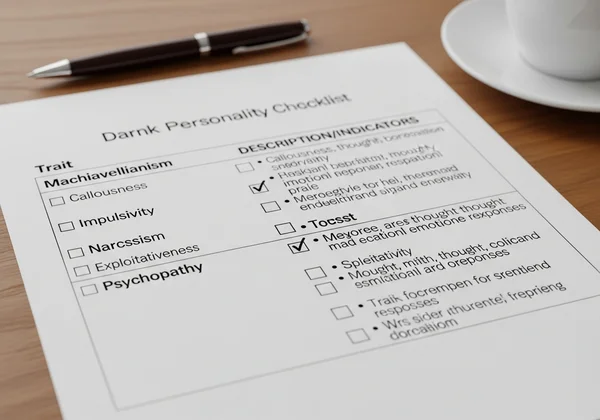
If you are curious about where you stand, we invite you to try the Dark Triad test on our platform. This tool is designed for educational exploration and personal curiosity. It measures three overlapping traits: narcissism, psychopathy, and Machiavellianism. By answering a series of scientifically-backed questions, you can see a visual representation of your personality profile. This is not a clinical diagnosis. It is a starting point for deeper self-discovery and a way to quantify the traits we have discussed in this comprehensive guide.
The Dark Intersection: Malignant Narcissism and the "Narcissistic Psychopath"
In some cases, the lines between narcissism and psychopathy blur into a more complex profile. This is often where the most "toxic" behaviors emerge in real-world scenarios.
When Traits Overlap: The Profile of Malignant Narcissism
Malignant narcissism is a term used to describe a person who possesses the grandiosity of a narcissist but also the aggression and lack of remorse found in psychopathy. They do not just want to be better than you; they often want to see you fail. This is a dangerous intersection where the ego’s need for validation meets the psychopath’s desire for destruction. Understanding this overlap is crucial because it explains why some individuals seem to take genuine pleasure in harming others’ reputations or emotional well-being.
What Exactly Is a "Narcissistic Psychopath"?
The phrase "narcissistic psychopath" is popular in search results, but is it a real classification? In clinical psychology, these are separate constructs. However, in behavioral terms, the phrase accurately describes an individual who exhibits high scores in both categories. These individuals are often highly successful in corporate or political environments because they possess the charm to climb the ladder and the coldness to remove anyone in their way. They are the ultimate "social predators" who wear a perfectly crafted mask of sanity.
[Advanced Insight] Understanding the "D-Factor"
Recent psychological research has introduced the "D-Factor," or the Dark Factor of Personality. This theory suggests that all dark traits—narcissism, psychopathy, Machiavellianism, and even sadism—stem from a single common core. If someone scores high in one area, they are statistically more likely to have traits in others. This "D-Factor" represents the tendency to put one's own goals above the interests of others, often accompanied by beliefs that justify their malevolent behavior.
Recognizing the Mask: Behavioral Patterns in Real Life
How do these traits manifest when you are sitting across the table from someone? Recognizing the mask of narcissism and psychopathy requires looking past the initial charm.
Red Flags: Identifying Traits in Relationships and Work
In the early stages of a relationship, both types can be incredibly magnetic. Narcissists frequently utilize "love-bombing" to secure your devotion and praise. Meanwhile, a psychopath might use "grooming" to find your vulnerabilities and test your boundaries. Observation reveals that these individuals often struggle to maintain long-term, stable friendships, which serves as a significant red flag. They often discard people once the "mask" begins to slip or the individual is no longer useful to them.
Reaction Patterns: How High-Trait Individuals Handle Failure
Watch how someone reacts when they lose a game or face professional criticism. Perceiving a slight often triggers "narcissistic rage" because the individual feels deeply wounded. On the other hand, a psychopath might remain eerily calm during a crisis. To them, failure is just a new data point to analyze. Instead of emotional outbursts, they often move on to the next target without a second thought, or launch cold, calculated revenge plots if they believe it serves their future goals. Their lack of emotional reactivity is often mistaken for "strength," but it is actually a sign of emotional detachment.

Moving Forward with Clarity and Insight
Understanding the complexities of narcissism and psychopathy provides you with a map of the human shadow. It allows you to move through the world with your eyes open. Whether you are dealing with a difficult boss, a confusing partner, or your own inner struggles, knowledge is your best defense. Remember that while these traits are fascinating to study, they have real-world impacts on mental health and social dynamics.
If you find that your relationship with someone possessing these traits is causing you significant distress, please consider seeking professional support from a counselor. A licensed therapist can help you set healthy boundaries and heal from the emotional exhaustion that often comes with these dynamics. For those who want to continue their journey of self-discovery, you can check your traits with this Dark Triad test to see how these concepts apply to your own personality profile.
Frequently Asked Questions
Why do narcissists need admiration while psychopaths seek utility?
Narcissists depend on others to sustain their fragile self-esteem. Without constant admiration, their sense of self begins to crumble. Psychopaths, however, do not care about your opinion of them. They see the world as a game of resources. If you have something they want—money, status, or connections—they will engage with you. If you have nothing to offer, they will likely ignore your existence.
Can individuals show dark traits without having a clinical disorder?
Yes, they certainly can. Most people possess these traits to some degree without meeting the strict criteria for a personality disorder. This is known as "subclinical" personality. For example, a successful CEO might have high narcissistic traits that drive their ambition, but they may still function within the bounds of social laws. Understanding your subclinical levels can help you manage your behaviors more effectively in your daily life.
Is narcissism linked to psychopathy?
They are considered "cousins" in the personality world. They both fall under the umbrella of "antagonistic" traits. Both types tend to be manipulative, self-centered, and low on empathy. However, the narcissist’s emotional neediness contrasts sharply with the psychopath’s emotional emptiness. They are linked by their shared disregard for the rights of others but separated by their internal emotional temperature.
Can behavioral patterns associated with these traits be managed?
While core personality traits are relatively stable over time, behaviors can be modified through self-awareness and dedicated therapy. For narcissists, building genuine self-esteem that doesn't rely on others can help. For those with psychopathic traits, "pro-social" psychopathy is possible, where the individual uses their cold logic and lack of fear for constructive purposes, such as surgery, law enforcement, or emergency response.
Which is worse: a psychopath or a narcissist?
"Worse" is a subjective term that depends on your experience. In terms of physical safety and social chaos, psychopathy is often considered more dangerous due to the lack of impulse control and remorse. However, in terms of daily emotional exhaustion and gaslighting, living with a narcissist can be equally draining. The "best" one is the one you have the strongest boundaries against.