Narcissist vs Sociopath vs Psychopath: Key Differences, Chart, and Self-Reflection
The search for narcissist vs sociopath vs psychopath usually starts with a practical worry: someone seems self-centered, manipulative, cold, volatile, or confusing, and you want language that makes the pattern easier to understand. These words overlap in everyday speech, but they do not mean the same thing. Narcissism points toward status, admiration, and self-image. Sociopathy usually points toward impulsive disregard for others. Psychopathy usually points toward colder, more calculated antisocial traits. If you want a nonjudgmental way to reflect on related personality patterns, an educational Dark Triad self-reflection tool can be a starting point, not a clinical conclusion.

Quick Answer: The Core Difference
A simple way to separate the three is to ask what seems to drive the behavior.
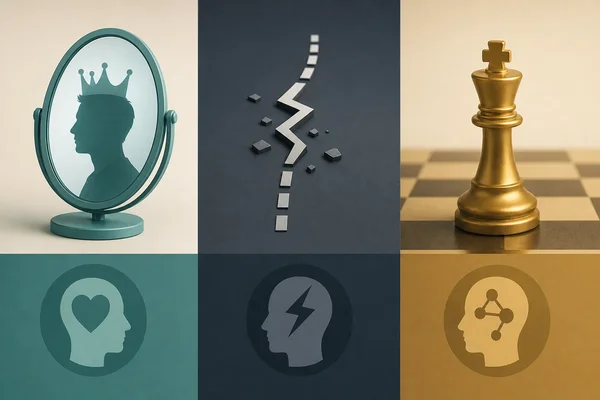
A narcissistic pattern is often organized around self-importance, admiration, image protection, envy, and sensitivity to criticism. The person may still care a great deal about how others see them, because attention and status help stabilize their self-esteem.
A sociopathic pattern is usually closer to antisocial behavior that is reactive, impulsive, deceitful, rule-breaking, or aggressive. The person may have a weak sense of guilt or empathy, but the behavior is often more emotionally volatile and easier to spot.
A psychopathic pattern is usually described as more emotionally detached, calculating, fearless, and remorseless. Popular culture often exaggerates this, so it is better to think in terms of traits and risk patterns rather than dramatic stereotypes.
In clinical language, "sociopath" and "psychopath" are not usually separate everyday labels that a layperson can assign with certainty. They are often discussed in relation to antisocial personality disorder or psychopathy research, while narcissism may refer to a trait pattern or, in more severe and impairing cases, narcissistic personality disorder.
Narcissist vs Sociopath vs Psychopath Chart
| Area | Narcissistic pattern | Sociopathic pattern | Psychopathic pattern |
|---|---|---|---|
| Main drive | Admiration, status, validation, control of image | Immediate gain, dominance, avoidance of rules | Power, control, stimulation, strategic gain |
| Emotional style | Proud, defensive, easily shamed or offended | Reactive, erratic, angry, impulsive | Cool, detached, low fear, low visible anxiety |
| Empathy | Often limited or self-focused | Weak, inconsistent, easily overridden | Very low or absent in severe presentations |
| Remorse | May appear when image, attachment, or consequences matter | Often limited, especially during conflict | Often shallow or missing in severe presentations |
| Manipulation style | Flattery, blame shifting, devaluation, attention control | Lying, intimidation, chaotic exploitation | Charm, planning, calculated deception |
| Relationship pattern | Needs admiration, may devalue when disappointed | Unstable, conflict-heavy, boundary-breaking | Shallow, instrumental, controlled |
| Common misconception | All confidence is narcissism | All rule-breaking is sociopathy | All psychopathy looks obvious or violent |
This sociopath vs psychopath vs narcissist chart is not a checklist for labeling a person. It is a map of tendencies. Real people are mixed, context-dependent, and shaped by history, stress, culture, incentives, and choices. A pattern becomes more concerning when it is persistent, exploitative, harmful, and resistant to accountability.
What Each Label Usually Points To
Narcissistic Traits
Narcissistic traits can range from normal self-focus to patterns that damage relationships. The central theme is usually self-esteem regulation. A narcissistic person may seem confident, but that confidence can be brittle. Criticism, loss of status, rejection, or being ignored may feel intolerable, so the person protects the self-image through defensiveness, blame, contempt, or withdrawal.
Common signs include grandiosity, a need for admiration, entitlement, envy, exploitation, and difficulty recognizing other people's inner lives. Still, narcissism is not the same as simple vanity. A person can be ambitious, proud, stylish, or socially confident without having a harmful narcissistic pattern. The question is whether the self-focus repeatedly overrides empathy, honesty, mutuality, and accountability.
Sociopathic Traits
Sociopathic is a common-language term, not a neat clinical box. It is usually used for antisocial patterns that feel impulsive, unstable, and harmful. A person described this way may lie, break promises, ignore rules, use intimidation, or act with little concern for consequences. Compared with a more psychopathic pattern, the behavior is often hotter: more reactive, more chaotic, and more emotionally explosive.
That does not make it harmless. A sociopathic pattern can still involve exploitation, aggression, legal problems, substance misuse, financial irresponsibility, or repeated betrayal. The key difference is often control. The person may act out of anger, boredom, revenge, or immediate reward rather than long-term strategy.
Psychopathic Traits
Psychopathic traits are usually associated with low fear, shallow emotion, low empathy, charm, callousness, and calculated behavior. A person high in these traits may understand what others feel intellectually but not respond with ordinary concern. They may also stay calm under pressure, use charm instrumentally, and plan harm or exploitation without obvious guilt.
This is why psychopath vs sociopath comparisons often contrast "cold and planned" with "hot and impulsive." The distinction is useful, but it can be oversimplified. Psychopathy exists on a spectrum, and not every person with psychopathic traits is visibly violent. The safer point for everyday readers is this: when charm, low remorse, repeated exploitation, and careful control appear together, boundaries matter more than winning an argument about the perfect label.
Psychopath vs Sociopath vs Narcissist Differences in Real Life
Motivation
Motivation is the cleanest starting point. Narcissistic behavior often protects a self-image: "I need to be admired, special, right, or superior." Sociopathic behavior often pursues immediate advantage: "I want this, and rules or feelings will not stop me." Psychopathic behavior often pursues control or gain with less visible emotional turbulence: "I can use this situation, and guilt will not slow me down."
This is also where narcissist vs psychopath questions become tricky. Both may charm, exploit, or lie. The narcissistic version often needs recognition and reacts strongly to humiliation. The psychopathic version may be less dependent on admiration and more focused on the utility of people, opportunities, or risks.
Empathy and Remorse
Empathy is not all-or-nothing. Someone may understand another person's pain but dismiss it, notice it only when consequences arrive, or feel it briefly without changing behavior. Narcissistic patterns often involve empathy that narrows when pride, shame, or status is threatened. Sociopathic patterns may show weak or inconsistent empathy. Psychopathic patterns, especially severe ones, are more associated with shallow emotional response and limited remorse.
The practical question is not "Do they ever say sorry?" It is "Does accountability change the pattern?" A sincere repair usually includes honesty, changed behavior, respect for boundaries, and patience with the harm done. Words alone are not enough.

Planning and Impulsivity
Planning separates many real-life examples. A sociopathic pattern may show rash promises, sudden anger, reckless spending, risky behavior, or explosive conflict. A psychopathic pattern may involve patience, concealment, and a more polished public image. Narcissistic patterns can go either way: some people react impulsively to criticism, while others carefully manage reputation and social rank.
This matters because different risks require different responses. Chaotic impulsivity may require distance, documentation, and immediate safety planning. Cold manipulation may require privacy protection, outside perspective, and fewer emotional negotiations. Narcissistic image management may require firm boundaries and less participation in praise, comparison, or blame cycles.
Relationship Impact
In relationships, narcissistic patterns can leave people feeling unseen, used for admiration, or punished for disappointing the person's self-image. Sociopathic patterns can leave people feeling unsafe, financially or emotionally destabilized, or trapped in unpredictable conflict. Psychopathic patterns can leave people feeling studied, controlled, deceived, or discarded once they are no longer useful.
The common thread is not a spooky label. It is repeated disregard for your reality. If someone consistently twists facts, ignores consent, punishes boundaries, or makes you afraid to speak honestly, the response should focus on support and safety, not on proving which category fits best.
Where Machiavellianism and Dark Empath Fit
The search results around psychopath sociopath narcissist Machiavellian often point into the Dark Triad: narcissism, Machiavellianism, and psychopathy. Machiavellianism is less about admiration and more about strategic manipulation, long-term self-interest, and emotional detachment. Someone can be narcissistic and Machiavellian, psychopathic and Machiavellian, or show milder everyday traits without fitting a clinical disorder.
That is why the Dark Triad trait framework can be useful for reflection. It separates narcissism, psychopathy, and Machiavellianism as trait dimensions instead of forcing every difficult person into a single dramatic label. It also keeps the focus on patterns: manipulation, empathy, impulsivity, status needs, and control.
"Dark empath" is another popular term. It usually describes someone who appears emotionally perceptive but may use that insight manipulatively. It is not the same as being a psychopath, sociopath, or narcissist. A person can read emotions well and still behave selfishly; emotional perception only becomes relationally healthy when it is paired with care, restraint, and respect.

How to Respond Without Turning Labels Into Verdicts
If you are trying to make sense of a difficult person, slow the labeling process down. Strong labels can feel clarifying, but they can also make you overlook what matters most: the behavior, the pattern, the impact, and your options.
Start with observable facts. What happened? How often? What changed after feedback? Did the person respect "no"? Did they repair harm without demanding instant forgiveness? Did they become more honest over time, or did the story keep shifting?
Then protect your boundaries. Use short, specific statements. Reduce oversharing with people who weaponize personal information. Keep records if the situation involves work, money, custody, threats, or repeated denial of facts. Bring in trusted support instead of trying to solve the dynamic alone.
Finally, keep compassion and clarity separate. You can recognize that personality patterns often have complex roots while still refusing to excuse harm. You do not need to hate someone to step back from them. You do not need a perfect label to decide that a pattern is not healthy for you.

Use the Narcissist vs Sociopath vs Psychopath Question for Safer Reflection
The healthiest use of narcissist vs sociopath vs psychopath is not to turn people into villains. It is to notice patterns with more precision. Narcissism asks you to watch status, admiration, entitlement, and shame reactions. Sociopathy asks you to watch impulsive disregard, deception, aggression, and rule-breaking. Psychopathy asks you to watch callousness, shallow emotion, calculated exploitation, and low remorse.
If you are reflecting on your own traits, keep the same care. A high-trait moment is not a life sentence. Ask what situations bring out control, defensiveness, emotional distance, or lack of empathy. Then look for small, repeatable changes: pausing before reacting, telling the truth sooner, respecting limits, asking how your behavior landed, and seeking professional support when patterns are harming life or relationships.
For a structured but low-pressure starting point, you can explore a private personality-trait reflection and use the result as a conversation prompt with yourself, a therapist, or a trusted professional. The goal is insight and better choices, not a fixed identity.
FAQ
What is the main difference between a narcissist, sociopath, and psychopath?
A narcissistic pattern usually centers on admiration, status, entitlement, and self-image protection. A sociopathic pattern usually centers on impulsive disregard for rules, safety, or other people's rights. A psychopathic pattern usually centers on colder emotional detachment, calculated manipulation, and shallow remorse. These are educational distinctions, not labels to apply with certainty from a distance.
Which is worse: psychopath or narcissist?
"Worse" depends on the behavior, severity, context, and risk. A narcissistic pattern can be deeply harmful in relationships, especially through devaluation, blame, or emotional control. A psychopathic pattern is often considered higher risk when it includes callousness, planning, and lack of remorse. Focus on safety, boundaries, and repeated behavior rather than ranking labels.
Which is worse: psychopath, sociopath, or narcissist?
Any of the three patterns can cause harm when traits are severe and persistent. Psychopathic traits may raise concern when they involve calculated exploitation. Sociopathic traits may raise concern when they involve volatility, aggression, or reckless behavior. Narcissistic traits may raise concern when admiration needs override empathy and accountability. The practical question is what the person does and whether the pattern changes.
Is sociopath vs psychopath an official clinical split?
In everyday language, people often separate sociopathy and psychopathy by impulsivity versus calculation. In clinical settings, these terms are more complex and are often discussed in relation to antisocial personality disorder or psychopathy measures. A formal clinical opinion requires trained evaluation, history, context, and impairment, not a quick online comparison.
Can a narcissist truly love someone?
Some people with narcissistic traits can feel attachment, affection, and care, but they may struggle when love requires humility, mutuality, repair, or tolerating criticism. The more severe and rigid the pattern, the more relationships may become organized around admiration and control. Look for consistent respect, accountability, and changed behavior rather than relying only on loving words.
What did Jesus say about narcissists?
The Bible does not use the modern psychology word "narcissist." Many readers connect the topic with teachings about pride, humility, hypocrisy, selfishness, and love of neighbor, but it is better not to turn a religious text into a clinical label. If faith matters to you, combine spiritual reflection with practical boundaries and qualified support when a relationship feels unsafe or harmful.
Is there a psychopath vs sociopath vs narcissist test?
There are educational personality tools that explore related traits, especially Dark Triad traits such as narcissism, Machiavellianism, and psychopathy. They can support self-reflection, but they are not a clinical diagnosis and should not be used to label another person. Use any result as a prompt for learning, journaling, or discussion with a qualified professional.