Psychopathic Narcissism: Traits, Examples, and Safer Ways to Respond
Psychopathic narcissism is a phrase people often use when narcissistic traits and psychopathic traits seem to appear together. It is not a formal label for judging someone, and it should not be used as a shortcut for a clinical assessment. Still, the idea can help you notice a pattern: entitlement, self-importance, low empathy, manipulation, risk taking, and little visible remorse. If you are trying to understand that pattern in yourself, a relationship, or a workplace, the educational framework at a private Dark Triad self-reflection tool can give you a more structured place to start.

What Psychopathic Narcissism Means
The phrase usually points to overlap between two trait clusters. Narcissistic traits center on inflated self-importance, a strong need for admiration, entitlement, sensitivity to status, and difficulty valuing other people's needs when they conflict with the person's own image. Psychopathic traits center more on callousness, shallow emotional response, impulsivity, thrill seeking, deceit, and reduced concern for consequences.
When these traits overlap, the result can feel especially destabilizing to people nearby. A person may want admiration and dominance, but also show a low emotional cost for lying, exploiting, or walking away from harm. That combination is why searchers look for terms like narcissistic psychopath examples or psychopathic narcissism traits. They are usually trying to name repeated behavior, not memorize technical vocabulary.
It helps to separate three ideas. First, narcissism can refer to everyday self-centeredness, a measurable personality trait, or a clinically significant pattern. Second, psychopathy is commonly used in research and forensic psychology as a trait construct, while clinical systems may use related but different language. Third, "psychopathic narcissism" is a descriptive overlap term, not a verdict about a whole person.
Psychopathic Narcissism Traits to Watch For
No single trait proves anything on its own. The meaningful signal is a repeated pattern across contexts, especially when feedback, boundaries, or consequences do not change the behavior. Common psychopathic narcissism traits may include:
- Charm that quickly becomes control when admiration fades.
- Entitlement paired with lying, intimidation, or strategic omission.
- Public confidence with private contempt for other people's limits.
- Anger or retaliation when status, control, or special treatment is challenged.
- Little visible guilt after harmful choices, followed by blame shifting.
- Risk taking that affects partners, coworkers, friends, or family members.
- Selective empathy: understanding what others feel, then using that knowledge to gain leverage.
The pattern can look polished from the outside. Someone may appear ambitious, witty, composed, or socially skilled. The concern is not confidence by itself. The concern is confidence combined with exploitation, poor accountability, and disregard for the emotional or practical impact on others.
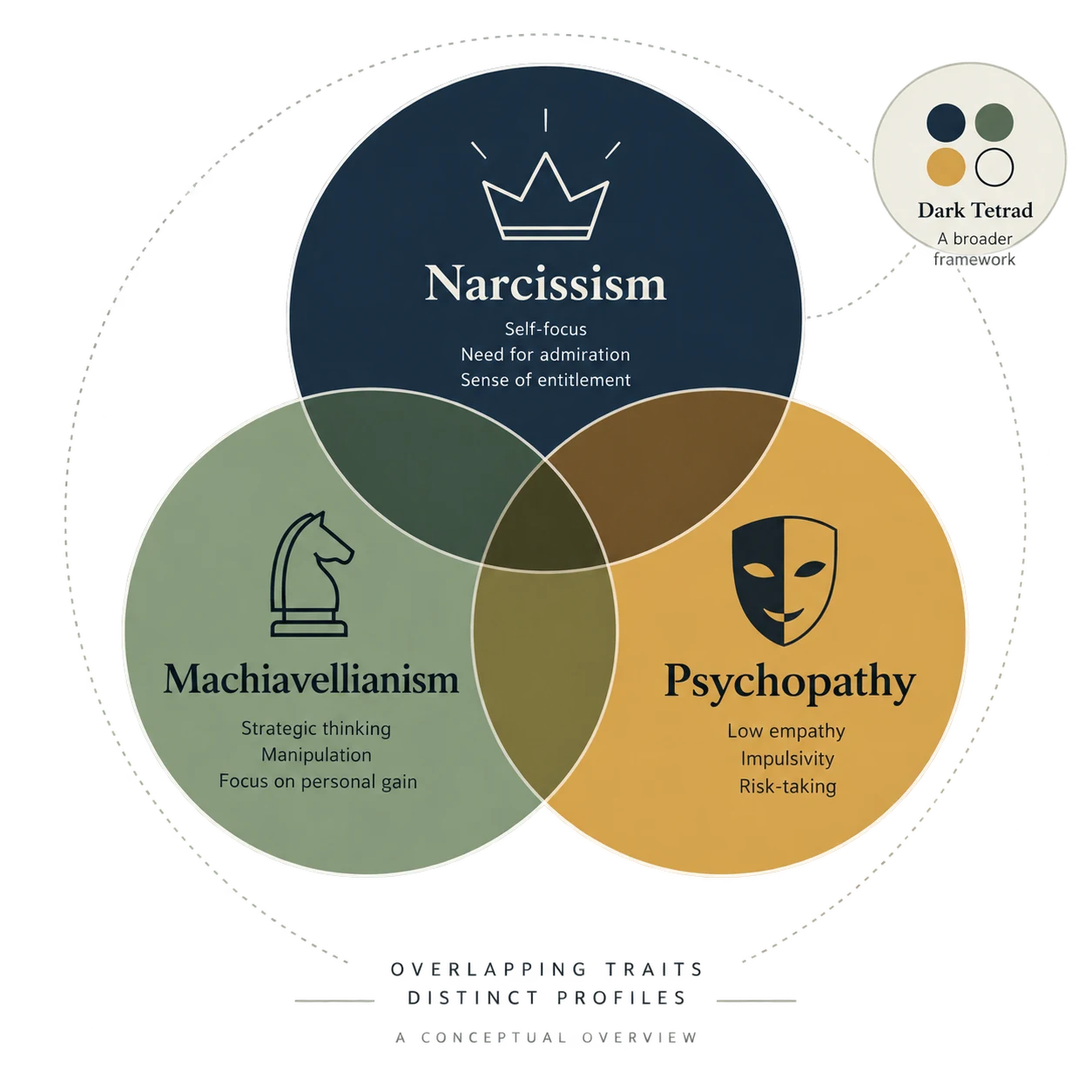
Narcissism, Machiavellianism, Psychopathy, and Sadism
The Dark Triad describes narcissism, Machiavellianism, and psychopathy as related but distinct socially aversive traits. Narcissism leans toward self-importance and admiration seeking. Machiavellianism leans toward calculated manipulation and strategic self-interest. Psychopathy leans toward callousness, impulsivity, and low remorse. The Dark Tetrad adds everyday sadism, or enjoyment of cruelty, as a fourth trait.
This matters because a search phrase such as psychopathic narcissistic machiavellian sadistic can mix several ideas into one alarming label. A more useful question is: which behaviors are actually present? Is the person mainly image-driven and easily wounded by criticism? Are they coolly strategic? Are they impulsive and reckless? Do they seem to enjoy humiliation or distress? Different patterns call for different boundaries.
For readers who want to sort the three core dimensions without turning them into identity labels, a Dark Triad traits framework can support reflection. The goal is not to put someone in a box. It is to describe behavior clearly enough that you can make better decisions.
Narcissistic Psychopath Examples in Everyday Life
In a relationship, a person might idealize a partner at first, push for quick commitment, then use criticism, jealousy, or silence to regain control whenever the partner asks for respect. The narcissistic side seeks special treatment and admiration; the psychopathic side may show up as lying, risk taking, or emotional coldness after harm is done.
At work, the pattern might look like a charismatic colleague who takes credit, flatters leaders, undermines peers, and treats rules as obstacles for other people. When confronted, they may deny obvious facts, reframe themselves as the victim, or punish the person who raised the concern.
In family or friendship settings, the person may demand loyalty while offering little reliability in return. They may disclose private information, create competition between people, or apologize only when it helps them regain access.
Which Is Worse, Psychopath or Narcissist?
The better question is not which label is worse. It is which behaviors create risk, how often they happen, and whether the person can respond to limits. Narcissistic traits can be painful when they produce entitlement, contempt, or chronic invalidation. Psychopathic traits can be dangerous when callousness, deceit, impulsivity, or aggression are strong. When the traits overlap, the risk may rise because the person may feel entitled to exploit and less restrained by guilt.
Severity depends on context. A person with mild narcissistic traits may be self-promoting but still capable of care and accountability. A person with high callousness and impulsivity may create serious harm even without obvious vanity. A person who combines admiration hunger, manipulation, and low remorse can be especially hard to reason with because emotional appeals may not land.
Avoid debating labels during conflict. Focus on observable actions: broken agreements, threats, lies, coercion, isolation, money control, reputation attacks, or repeated boundary violations. Behavior is clearer than speculation about someone's inner world.

Psychopath Narcissist Relationship Patterns
A psychopath narcissist relationship may feel intense because the early stage can be rewarding. The person may mirror your interests, offer praise, or create a sense that you are uniquely chosen. Later, the same person may use withdrawal, ridicule, blame, or charm to keep control. This push-pull pattern can make the other person work harder for approval.
Several signs deserve attention:
- You feel you must manage their mood to avoid retaliation.
- Your boundaries become topics for negotiation instead of limits to respect.
- They are calm about your distress but highly reactive to criticism.
- Conflicts end with confusion, apology from you, or no real repair.
- Friends, coworkers, or family notice you seem smaller, anxious, or isolated.
Not every difficult relationship involves psychopathic narcissism. Stress, immaturity, trauma responses, substance use, and ordinary selfishness can also damage relationships. But if you repeatedly feel controlled, frightened, financially pressured, or cut off from support, prioritize safety and outside perspective over winning an argument.
How to Deal With a Narcissistic Psychopath Safely
Start with your own clarity. Write down specific behaviors, dates, agreements, and outcomes. This reduces the fog created by charm, denial, or shifting explanations. Keep the notes private and factual.
Set boundaries that depend on your behavior, not their permission. For example: "I will leave the room if insults begin," or "I will only discuss work decisions in the shared project channel." A boundary is stronger when it names what you will do and then follows through calmly.
Limit emotional debate when the other person uses conflict to gain control. Short, factual responses are often more useful than long explanations. Do not reveal every fear, wound, or plan to someone who has a history of using private information against you.
Build support outside the relationship. Talk with trusted people, a counselor, HR, legal support, or local services when appropriate. If there is stalking, threats, physical harm, coercive control, or financial abuse, treat the situation as a safety issue and seek qualified help in your area.
If you are reflecting on your own traits, use curiosity instead of shame. Notice whether you chase admiration, dismiss other people's needs, lie to avoid accountability, or treat relationships as contests.
When the Term Gets Misused
"Psychotic narcissistic sociopath" is a common search phrase, but it mixes concepts that do not mean the same thing. Psychotic relates to experiences such as delusions or hallucinations. Narcissistic relates to self-importance, admiration needs, entitlement, and empathy difficulties. Sociopath is an informal word often used for antisocial patterns, but it is not a precise everyday label.
The same caution applies to "criminal narcissist." Criminal behavior is about actions that break law or harm others. Narcissistic traits may appear in some people who commit harm, but narcissism alone does not equal criminality. Many people with narcissistic traits never commit crimes, and harmful behavior can come from many motives.
Language matters because labels can escalate conflict and stigma. Clear descriptions are usually more useful: "They lied about money," "They ignored repeated refusals," "They threatened my job," or "They mocked me when I asked for respect." These statements are easier to evaluate and act on.
Using Psychopathic Narcissism as a Reflection Lens
Psychopathic narcissism is most useful as a reflection lens, not a weapon. It can help you ask better questions: What behavior keeps repeating? What happens when I set a limit? Does the person repair harm, or only protect image and access? Am I safe enough to continue engaging?
For self-reflection, the same lens can become constructive. Dark traits are not a moral sentence. They are patterns that can be noticed, managed, and discussed with support. If you recognize entitlement, callousness, manipulation, or status hunger in yourself, pause before turning that into either denial or self-condemnation. Look for one behavior you can change: tell the truth sooner, tolerate criticism longer, ask before assuming, or repair impact without demanding instant forgiveness.
The healthiest use of this topic is practical: name patterns, reduce harm, strengthen boundaries, and choose support. A reflective resource such as an educational personality test for dark traits can be a starting point when it is paired with honest feedback and qualified support when needed. Psychopathic narcissism may be a heavy phrase, but your next step can be simple and grounded.

FAQ
What is an extreme narcissist called?
People may use informal terms such as malignant narcissist, grandiose narcissist, or narcissistic psychopath, but these terms are not interchangeable. A more careful approach is to describe the specific traits or behaviors you are seeing, such as entitlement, exploitation, rage after criticism, or low remorse.
What are the traits of a criminal narcissist?
There is no single official everyday category called "criminal narcissist." In plain language, people may mean someone who combines narcissistic traits with unlawful, exploitative, or aggressive behavior. Focus on actions such as deception, threats, coercion, theft, stalking, or repeated boundary violations rather than assuming narcissism explains everything.
Can you have a healthy relationship with someone who has NPD?
Some relationships improve when the person has insight, takes responsibility, respects boundaries, and participates in appropriate professional care. A relationship is unlikely to feel healthy if contempt, manipulation, intimidation, or repeated harm continue without repair. Your safety and support network matter more than preserving a label.
What is the difference between narcissism and pathological narcissism?
Narcissism can describe ordinary self-focus or a personality trait that varies by degree. Pathological narcissism refers to more rigid, impairing patterns involving self-esteem regulation, entitlement, empathy difficulties, and interpersonal dysfunction. Only qualified professionals can evaluate clinical-level patterns.
What are psychopathic narcissism traits in simple terms?
In simple terms, look for entitlement plus emotional coldness. The person may expect admiration, use charm or pressure to control others, lie easily, avoid ownership, and show little concern when their choices hurt people.
How do you respond to a narcissistic psychopath?
Use behavior-based boundaries, keep records where appropriate, avoid emotional debate, and involve outside support. If you feel unsafe, threatened, isolated, or controlled, prioritize practical safety planning and qualified help over trying to persuade the person to understand your feelings.
Is psychopathic narcissism the same as the Dark Triad?
No. The Dark Triad includes narcissism, Machiavellianism, and psychopathy. Psychopathic narcissism usually refers to overlap between narcissistic and psychopathic traits, while Machiavellianism describes a more calculated, strategic style of manipulation.