What Is the Opposite of Superiority? Meanings in Psychology, Work, and Anatomy
The opposite of superiority is not always one word. In a dictionary sense, the direct opposite is usually inferiority. In social life, the healthier opposite may be humility, equality, or mutual respect. In anatomy, the opposite of superior is inferior. In the workplace, the opposite of a superior may be a subordinate, junior role, or direct report, depending on the sentence.
That range matters because people often search "opposite of superiority" when they are trying to understand both language and behavior. If the question connects to narcissism, status, or Dark Triad traits, an educational resource such as a non-judgmental Dark Triad self-reflection tool can help you think in patterns instead of labels. This article explains the main meanings without turning a word question into a clinical claim.

The Short Answer: Inferiority, Humility, or Equality?
If you need the strict antonym of superiority, use inferiority. Superiority means being higher in rank, quality, position, or perceived worth. Inferiority means being lower in rank, quality, position, or perceived worth. That is why "inferiority" is the cleanest answer for many vocabulary questions.
But everyday language is messier. If superiority means "acting as if you are above other people," the opposite is often humility. Humility does not mean thinking you are worthless. It means holding a realistic view of yourself while still respecting other people. If superiority means an unequal power relationship, the opposite may be equality or parity. If superiority means a formal role, the opposite may be subordinate.
A useful rule is to ask what kind of superiority you mean:
- Rank: the opposite is lower rank, junior status, or subordinate position.
- Quality: the opposite is inferiority, weakness, or lower quality.
- Attitude: the opposite is humility, modesty, or grounded confidence.
- Relationship: the opposite is equality, mutuality, or respect.
- Anatomy: the opposite is inferior.
So the best antonym depends on whether you are talking about grammar, psychology, work, or the body.
Why "Superior" Changes Meaning by Context
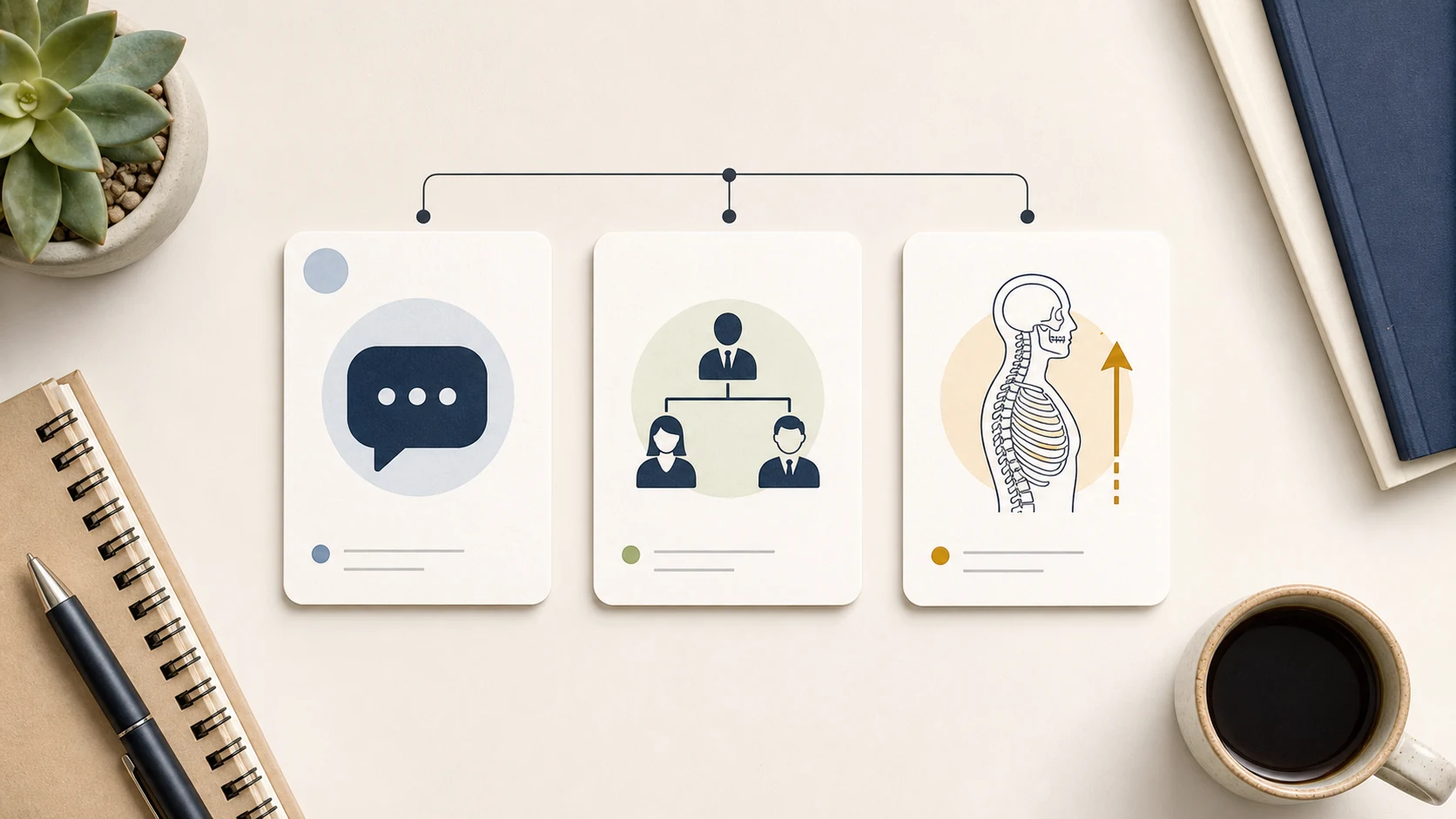
The word superior can describe a position, a comparison, a role, or an attitude. That is why a single answer can feel too narrow.
Everyday speech
In everyday speech, "superior" may mean better, higher quality, more skilled, or more important. The opposite of superior in this sense may be inferior, worse, lower, weaker, lesser, or less capable. Some of these words can sound harsh, so choose carefully. "Less experienced" or "less developed" is often clearer and kinder than "inferior" when you are describing a person.
Anatomy and medical terminology
In anatomy, superior means above or toward the head. The opposite of superior in anatomy is inferior, meaning below or toward the feet. This use is directional, not emotional. If a structure is inferior to another structure, that does not mean it is worse. It only describes location.
That is also why "opposite of caudal same as superior" can be confusing. In many human anatomy contexts, cranial means toward the head and caudal means toward the tail or feet. Superior often overlaps with cranial, while inferior often overlaps with caudal, but the exact wording depends on the body position and species being discussed.
Workplace roles
At work, a superior is often a manager, supervisor, senior employee, or officer with formal authority. The opposite of a superior at work may be a subordinate, direct report, junior colleague, employee, or team member. In professional writing, "direct report" is usually more neutral than "subordinate."
Power and dominance
"Power or superiority over others" can point to dominance, authority, control, or status. Those words are not identical. Authority can be legitimate and role-based. Dominance often describes a social pattern where one person tries to control the interaction. When the concern is behavior, not job title, humility and mutual respect are more useful opposites than simple inferiority.
The Opposite of a Superiority Complex
The opposite of a superiority complex is commonly called an inferiority complex. A superiority complex is a pattern of acting better, more important, or more entitled than others. An inferiority complex is a pattern of feeling lesser, inadequate, or chronically below others.
However, the two can overlap. Some people who appear superior are not calm or confident underneath. Their status-seeking can be a defense against shame, insecurity, or fear of being overlooked. This is sometimes called false superiority: the outward pose looks grand, but the inner state may feel fragile.
That does not mean every confident person is hiding self-doubt, and it does not mean every self-doubting person acts superior. Human behavior is more varied than that. The practical point is that superiority and inferiority can both keep attention locked on rank: Am I above, or am I below? A healthier alternative is not self-erasure. It is realistic self-respect paired with respect for others.
This distinction matters for narcissism-related searches. Narcissistic traits can involve grandiosity, admiration-seeking, sensitivity to criticism, or a strong need to feel special. Those patterns can connect with superiority, but a blog article cannot evaluate a person from a few traits. For safer reflection, structured personality-trait reflection is best treated as an educational starting point, not a final label.
Superior vs. Superiority: Useful Antonyms by Use Case
Here is a quick map for choosing the right opposite.
| If the meaning is... | Better word for the opposite | Example |
|---|---|---|
| Higher quality | Inferior, lower quality | "The second version was inferior in durability." |
| Higher rank | Lower-ranking, junior, subordinate | "A junior officer reported to the superior officer." |
| Acting above others | Humble, modest, respectful | "Her tone was humble rather than superior." |
| Unequal status | Equal, peer, counterpart | "They negotiated as equals." |
| Anatomical direction | Inferior | "The chest is superior to the abdomen; the abdomen is inferior to the chest." |
| Workplace manager | Direct report, employee, team member | "Managers and direct reports need clear expectations." |
Synonyms of superiority include dominance, advantage, supremacy, excellence, seniority, priority, and authority. They are not interchangeable. "Excellence" can be positive. "Dominance" can imply control. "Seniority" often means time, rank, or role. When you choose an opposite, match the exact meaning.
Also watch for unrelated search suggestions. "Opposite of hollow" is solid or full. "Opposite of modern" is ancient, old-fashioned, or traditional. Those are different vocabulary questions, not useful antonyms for superiority.
At Work: Replace Status Pressure With Accurate Respect
Workplace searches often mix vocabulary with emotion. Someone may ask for "another word for superior at work" because they are writing a policy, but someone else may be asking because a manager behaves as if rank makes them personally better.

In formal language, "supervisor," "manager," "senior leader," "officer," or "team lead" may be more specific than "superior." For the opposite, use "direct report," "junior colleague," "employee," or "team member." These terms describe structure without implying that one person is worth more than another.
In behavior, the opposite of superiority is not letting everyone do whatever they want. Good leadership still includes standards, feedback, and responsibility. The difference is tone and motive. Status pressure says, "I matter more, so your view matters less." Accurate respect says, "Roles differ, but basic dignity does not."
That shift is especially important in teams where control, manipulation, admiration-seeking, or low empathy may create friction. You do not need to label a coworker to respond wisely. You can notice patterns: Who interrupts? Who takes credit? Who avoids accountability? Who treats feedback as humiliation? Who uses rank to shut down ordinary questions?
Those observations are more useful than name-calling. They help you set boundaries, document decisions, ask for clarity, and keep conversations focused on behavior.
A Reflection Exercise for Superiority and Inferiority Patterns
If this topic feels personal, try a short reflection exercise. It is not a clinical assessment. It is simply a way to notice when your mind moves toward above-or-below thinking.

First, write down a recent situation where comparison became intense. Maybe you felt dismissed, criticized, overlooked, or eager to prove you were right. Then answer four questions:
- What did I want in that moment: respect, safety, credit, control, approval, or distance?
- Did I move toward superiority, inferiority, or equality?
- What behavior did others actually see?
- What would grounded confidence have looked like instead?
Grounded confidence is different from superiority. It lets you say, "I have strengths," without adding, "therefore I am above you." It also lets you say, "I made a mistake," without collapsing into, "therefore I am below everyone." That middle position is often the most useful opposite of superiority in real life.
What the Opposite of Superiority Can Teach About Self-Awareness
The opposite of superiority is inferiority when you need a direct antonym. It is inferior in anatomy. It may be subordinate, junior, or direct report in a work hierarchy. But when the topic is personality, the healthiest opposite is usually not inferiority at all. It is humility, equality, and accurate self-respect.
That matters because superiority and inferiority can both revolve around rank. One says, "I must be above." The other says, "I am stuck below." A more flexible mindset asks better questions: What is true here? What role do I have? What impact is my behavior having? What can I change without shaming myself or others?
For readers exploring narcissism, Dark Triad traits, or status-driven behavior, an educational Dark Triad trait guide can support reflection while keeping the right boundary: personality traits are patterns to understand, not insults to throw at yourself or someone else.
FAQ
What is the opposite of superiority?
The direct opposite of superiority is inferiority. But depending on context, the opposite may also be humility, equality, lower rank, or mutual respect.
Which is the best antonym for superior?
The best antonym for superior is usually inferior when you mean lower in quality, rank, or position. If you mean attitude, humble or modest may be better.
What is the opposite of a superiority complex?
The common opposite of a superiority complex is an inferiority complex. In healthy behavior, though, the better opposite is grounded confidence and respect for others.
What is a word for less superior?
Possible words include inferior, lower-ranking, junior, subordinate, lesser, weaker, or less advanced. Choose the word that fits the context and tone.
What is the opposite of superior in anatomy?
In anatomy, the opposite of superior is inferior. Superior means above or toward the head; inferior means below or toward the feet.
What is the opposite of superior at work?
At work, the opposite of a superior may be a subordinate, direct report, employee, junior colleague, or team member. "Direct report" is often the most neutral business term.
Is humility the same as inferiority?
No. Humility is realistic self-understanding with respect for others. Inferiority means being lower in rank, position, quality, or perceived worth.